
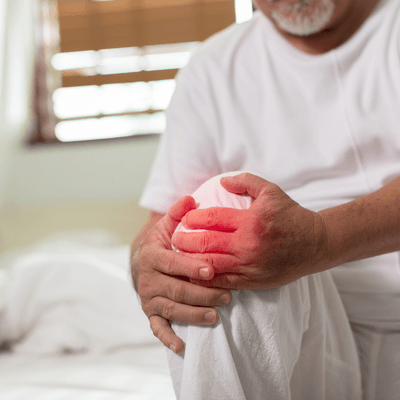
Bursae are fluid-filled sac-like structures found near bony protuberances. They typically rest between bones and other structures, such as muscles, tendons or ligaments and prevent friction between these structures that would otherwise move against each other. There are many bursa throughout the body, varying in size. Bursitis is irritation or inflammation of a bursa, which may cause it to become swollen and painful.
The most commonly affected bursae in the body include the following:
- Pes anserine: sits between the hamstring tendons and the tibia
- Trochanteric: is located in the lateral hip and sits between the gluteus maximus tendon and the insertion of the gluteus medius tendon on the femur
- Olecranon: at the back of the elbow it protects the tricep tendon as it passes over the ulnar
- Prepatellar: over the knee cap just under the skin
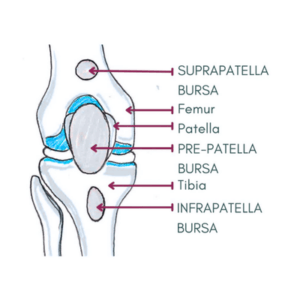
Bursa of the kneecap
These help to prevent friction between the patella and the quadriceps tendon that runs over the top and attaches onto the tibia/ shin bone.
Bursitis can be caused by overuse injuries, trauma or inflammatory disorders. The most common cause is prolonged pressure, where the surrounding structures place a continuous stress on the bursa (for example, leaning on your elbow or kneeling for too long on hard surfaces), or through repetitive motions. Alternatively, a direct sudden pressure such as trauma can cause the bursa to become inflamed; this incident isn’t always immediately obvious.
Each bursa around the body has certain incidents or activities that are more likely to result in bursitis; for example, the olecranon bursitis (at the back of the elbow) is more likely in those that work in manual labour positions as necessary tasks will require
repetitive movements and leaning or may be knocked. While the subcutaneous calcaneal bursa (found at the heel of the foot) can be inflamed from footwear that is too tight or poorly fitting.
When a bursa does get inflamed, there is local pain, limited range of motion of the joint, and pain with certain movements. However, in more chronic cases there may not be any pain as the structures have had time to accommodate the increase in fluid. In both cases, there is often local swelling, and changes in the way nearby muscles and joints are functioning may also contribute to symptoms.
In the early stages, reducing activities that aggravate symptoms, using ice if it provides relief, and gradually returning to movement as symptoms settle may help. An osteopath can provide advice on activity modification, exercises and symptom management, and where appropriate work alongside your GP or other healthcare professionals. Management depends on the cause and severity of the condition. It commonly includes education, activity modification and exercises to improve strength and movement. An osteopath may also use hands-on techniques where appropriate as part of an individual management plan.
Most cases of bursitis improve with appropriate management over time. However, if you experience severe pain, significant swelling, redness or warmth around a joint, fever, or symptoms that persist or worsen despite self-management, seek prompt assessment from a healthcare professional. These symptoms may indicate a more serious condition that requires further investigation or treatment.
Williams CH, Jamal Z, Sternard BT. Bursitis. [Updated 2022 Jul 24]. In: StatPearls [Internet]. Treasure Island (FL): StatPearls Publishing; 2022 Jan-. Available from: https://www.ncbi.nlm.nih.gov/books/NBK513340/
If appropriate, you can find an Osteopathy Australia osteopath near you using the Find an osteo directory.
This article has been adapted by Osteopathy Australia for What is Osteo. It was originally published by Osteopathy Australia member www.rockhopperclinic.com.au
For more information, click here.